Small steps, space to listen: takeaways from Revival’s Parent Talk & Support
Reflections from our evening with Natalie from Campfire Counselling on 20 October 2026.
“Do you want my advice, or would you like me just to listen?”
It is a simple question, but it is one of the things that has stayed with me after our Parent Talk & Support evening at Revival. When our children are struggling, we can be so keen to help that we move straight into suggestions, questions and solutions. This was a reminder to pause and find out what they need from us in that moment.
Natalie from @campfirecounselling brought both her professional experience as a counsellor and former teacher and her personal experience as a mum. That combination made for an evening full of practical ideas, thoughtful discussion and recognition of how complicated parenting can feel.
The session focused on supporting children and teenagers with their mental health, including anxiety, low mood, neurodivergence and difficulties attending school. We covered a great deal. These are just some the ideas I particularly wanted to remember and share.
Start with ourselves: am I okay to co-regulate?
One of my strongest takeaways was that supporting our children includes noticing our own needs.
Co-regulation is the support we offer through our presence, voice and responses while a young person is finding it difficult to manage their feelings.
Natalie introduced SNAC, beginning with the ABC of self-care for parents and carers.
A – Am I okay to co-regulate? Have I looked after myself? Am I in the best position to support my child at this moment, or do I need a pause first? It is a useful question when we are tired, worried or already feeling overwhelmed. Checking in gives us a chance to notice what we are bringing into the interaction.
B – Breathe. Breathing was discussed as something we can return to before, during or after a difficult moment. But also one of the things that can feel like an added pressure – and often not the best thing to say to our young person either – breathe, just breathe. So by just undertaking simple breath work exercises, and explaining what we are doing for others to mirror can be an easier approach.
One example was breathing in for five counts and out for seven, gently and at a comfortable pace. Another was the “hiccup breath”: breathing in, adding another short breath on top, then letting the breath out slowly.
That double-inhale pattern followed by a longer exhale is commonly called a physiological sigh. You can read more about it in this Stanford Medicine explanation. Breathing should feel comfortable; there is no need to force the count or depth, and you can return to your usual breathing if it feels uncomfortable.
C – Calm and slow down. Speak a little more slowly. Let movements become calmer. Give the interaction some space. These were practical reminders about how we approach a moment, as well as what we say.
Notice, anchor and invite
The remaining parts of SNAC focus on what we do alongside our young person.
N – Notice. Natalie described modelling awareness by saying something such as:
“I’m noticing my toes touching the end of my shoes.”
We can describe what we notice ourselves, without turning it into another task the child has tocomplete. They have an opportunity to join in, with no pressure to get it right.
A – Anchoring. Anchoring brings attention towards a steady physical or sensory experience in the present moment. The ideas discussed included feeling feet on the floor, gentle movement,swaying and tapping. The emphasis was on finding something that feels helpful for that individual.
C – Consensual breath. Offer an invitation to breathe together. Model it and allow the young person to choose whether to join in. That element of choice is important, we can offer support in a way that leaves room for the child’s own response.
From red to amber: making the next step manageable
Natalie also described using a traffic-light approach with young people to explore how different situations make them feel. Something might feel red, amber or green. If it feels red, the next question is: what could help it feel a little more manageable, moving from red to amber?
That might mean breaking a challenge into smaller parts, adjusting an expectation or offering support for one particular step. This is the idea of “scaffolding”: putting support around the young person as they move forward. This is a helpful way to think about progress. We can recognise a small shift without expecting the whole difficulty to disappear.
There was also a thoughtful discussion about “green” situations. Natalie talked about noticing sustained high energy or activity that are identified as ‘green’, which might make us think everything was ‘good’. It might however indicate if a young person might actually be taking on more than they can comfortably sustain. Sometimes an apparently green period can be followed by a crash or burnout. The emphasis was on understanding the individual and their patterns. Even when they feel able to keep going, pacing activities, taking breaks and making room to decompress can still matter.
Rest does not always mean sitting still
Another point that resonated with many of the attendees was that rest looks different for different people. A quiet walk, gentle movement or a familiar activity might provide a break. Sitting still is not everyone’s easiest route to feeling settled. We also discussed recovery after panic or overwhelm: allowing time, familiar comforts and space, and recognising that the young person may not be ready to talk straight away. It was a reminder to consider what feels restorative to them, and how much we are asking of them in that moment.
Make space for a conversation
Some of the most useful ideas were very ordinary ones. Walking together. Sitting alongside each other. Allowing a conversation to happen during an everyday activity, without the intensity of a formal “we need to talk”.
“That looked hard. Do you want to talk about it?” offers a gentle opening.
And “Would you like advice, or would you like me just to listen?” gives them a say in what happens next. These were reminders that connection can begin with curiosity, patience and a willingness to leave some space.
Parents need somewhere to talk too
The discussion after Natalie’s talk was an important part of the evening. Parents shared their own stories, challenges, strategies and things they were still trying to work out. There was space for questions and for hearing how other families approach difficult moments. That is something extremely valuable about these evenings at Revival: the opportunity to bring professional
knowledge and lived experience into the same conversation, and to learn from one another.
Thank you to Natalie for sharing so openly, and to everyone who came along and contributed through talking or listening.
These are my personal takeaways from a wide-ranging discussion. Different approaches will suit
different children and families; individual concerns may need support tailored to your young person.
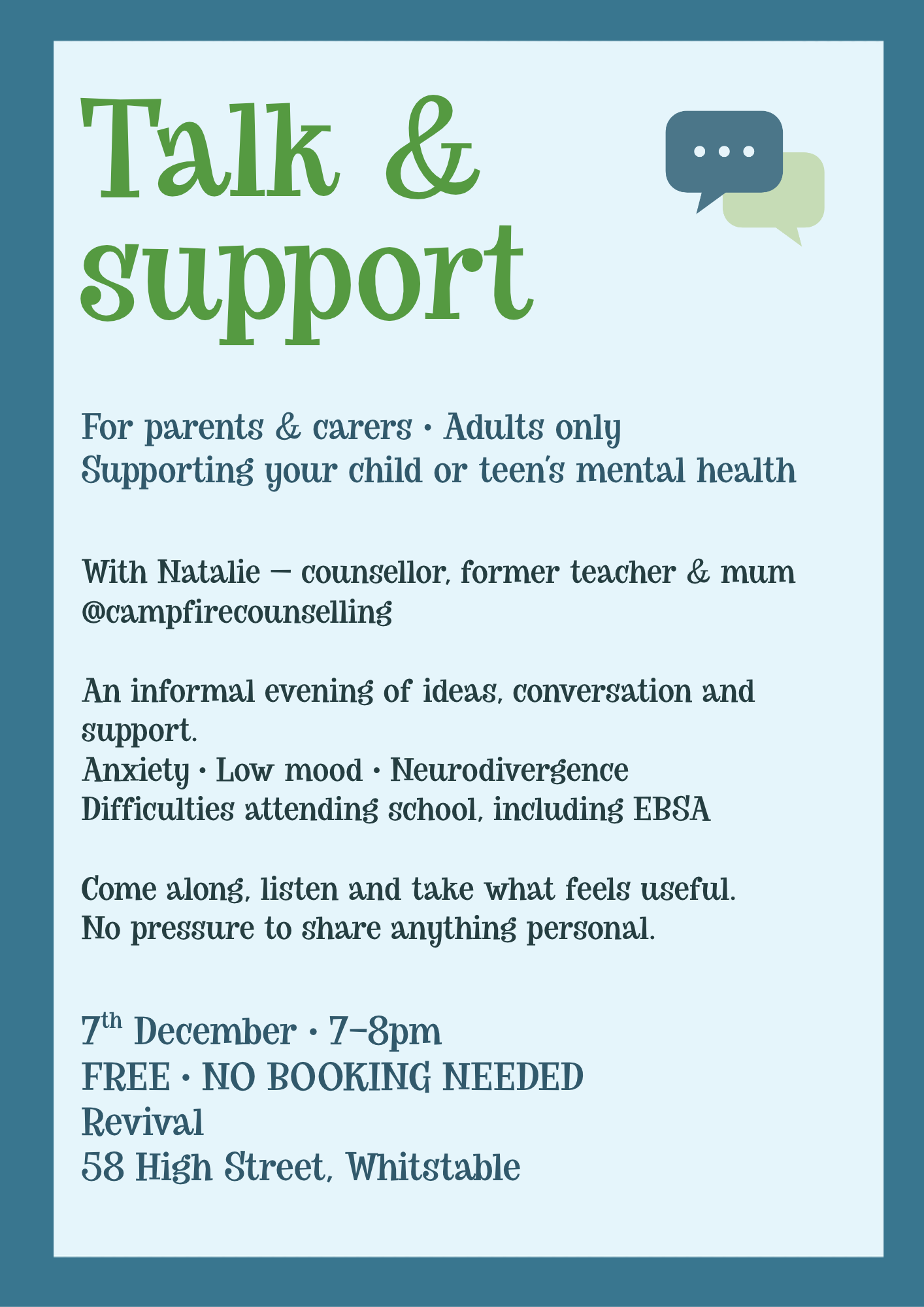
Join us for the next Parent Talk & Support
Our next session is 7 December 2026 at 7pm, at Revival, 58 High Street, Whitstable.
We are also delighted that Natalie will be joining Revival’s Mental Health Bank to offer these sessions monthly from January 2027.
We look forward to welcoming parents and carers for more conversation, practical ideas and mutual support. Come along, listen and take what feels useful, there is no pressure to share anything personal.